

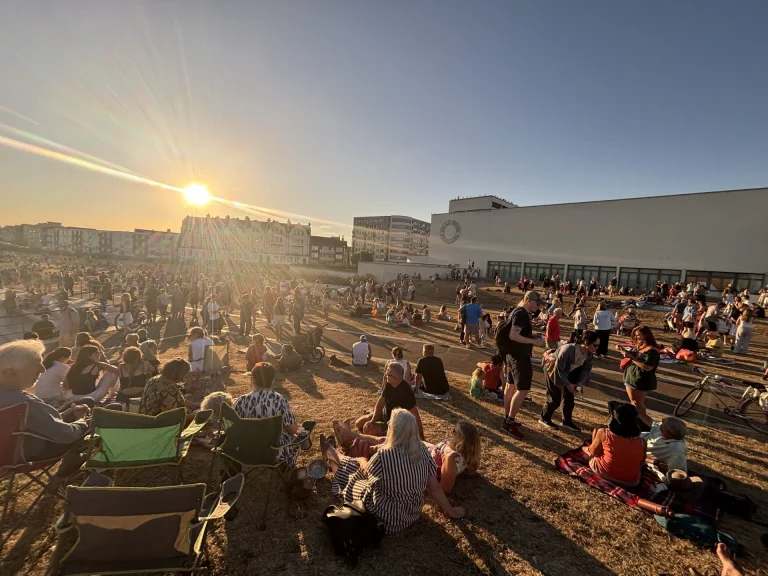
An irregular procession of visitors came through our doors today, all asking one question: did we sell eclipse glasses? We did not, and we apologise. A museum that holds dinosaur fossil bones, mummified crocodiles and Edwardian tourist souvenirs has a grip on the past, but not necessarily on the future.
But since the sky over Bexhill darkened to around nine-tenths this evening and the town turned out to see it, it seems a good moment to ask a better question. When has our town stood in the Moon’s full shadow, and who was here to see it? Totality is rare for any given spot on Earth. Bexhill has managed it four times in two thousand years, and each time an entirely different world was watching.
AD 19: the Iron Age coast
The earliest computed totality to touch our shore came on 21 June AD 19, a midsummer morning a generation before the Roman conquest. The people farming the coastal fringe below the Weald were Britons of the late Iron Age, living between the great tribal powers of the south-east while Cunobelin’s influence spread from the north of the Thames. Their intellectual class, the druids, kept close watch on the heavens, and midsummer already carried ritual weight. We can only guess at their response, but a sun extinguished at the solstice must have demanded interpretation, sacrifice, or both.
AD 118: Hadrian’s iron country
On 3 September AD 118, the shadow track ran along the south coast towards Selsey Bill, and Bexhill sat at its eastern edge. Hadrian had been emperor for barely a year. Our corner of Sussex was then industrial: the Classis Britannica, the Roman fleet, was working the Wealden iron deposits, and the bath-house at Beauport Park (now partially in bits in our stores) lies a short ride from here. Educated Romans knew an eclipse was the Moon’s doing rather than the gods’. Pliny had explained the mechanics decades earlier. The ironworkers themselves, a mix of Britons and migrant labour, may have been less philosophical when the furnace-light suddenly outshone the sky.
AD 758: the South Saxons, and a town about to be born
Perhaps the most timely totality fell on 12 April 758, when darkness swept the whole southern coast from Cornwall to Kent, passing directly over us. Sussex was then a fading kingdom of the South Saxons, sliding under the lordship of Mercia, whose new king Offa had seized power the year before. Fourteen years later, that same Offa would grant land at ‘Bexlei’ for a church, the charter from which our town counts its recorded existence. This total eclipse over Bexhill happened before Bexhill, on paper at least, actually existed. The clergy of the age had Bede on their shelves, and Bede had explained eclipses as natural shadow play a generation earlier. Whether that comfort reached the farmsteads of pre-charter Bexlei is another matter.
How do we know?
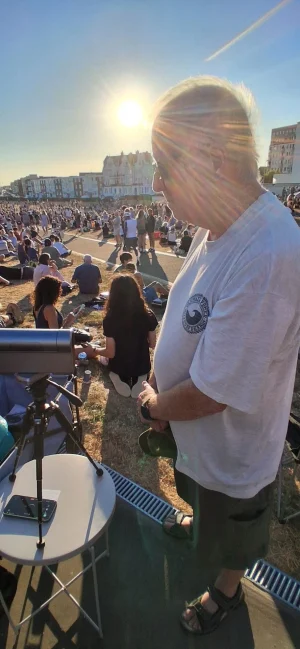
The basic eclipse geometry is well understood. NASA’s Five Millennium Canon lists all solar eclipses from 2000 BC to 3000 AD, allowing identification of those visible from Bexhill (50.84°N, 0.47°E). NASA uses the Julian calendar before 1582 and the Gregorian thereafter. The main limitation for ancient eclipses is ΔT, the mathematical uncertainty in Earth’s changing rotation rate. It is the difference between uniform astronomical time and time based on Earth’s slightly irregular spin. Because Earth’s rotation is not constant, past event timings cannot always be reconstructed precisely, but NASA’s algorithm can compile a fairly reliable list of total eclipses visible from Bexhill over the last few millennia.
1724: smugglers under a black sun
Our most recent totality came on 22 May 1724, near sunset, on a track that ran east through Hampshire and Sussex. George I was on the throne, Sir Isaac Newton was still alive, and the event had been well mapped and advertised. Science had domesticated the darkness. Bexhill was then a small farming and fishing parish on a coastline better known for the owlers, the wool-smuggling gangs who preferred their nights dark. One imagines mixed responses: wonder up at the vicarage, business opportunity down on the beach.
25 May 2142: book early
The computed record gives us our next appointment, and it is a generous one. On 25 May 2142 totality will cross the Channel Islands and the south-east coast, and the published track names Eastbourne, Bexhill and Hastings directly, offering two minutes 42 seconds of darkness. Bexhill will lead into the dark.
What will the town be like? The De La Warr Pavilion will be 207 years old and presumably mid-restoration. The museum will be approaching its 228th birthday, still explaining that the dinosaur footprints are real and that Annie Lady Brassey was actually from Hastings. If the coming decades go well, the promenade will still be there, defended by choices made in our own lifetime. And somewhere on the promenade, descendants of today’s visitors will walk into Bexhill Museum and ask whether we sell eclipse glasses.
This time we will be ready. The order goes in tomorrow. Allowing for delivery times, 116 years should just about cover it.
More information: A Millennium of British solar eclipses (1501–2500) AD, Journal of the British Astronomical Association, Vol 111, pp 88–98