

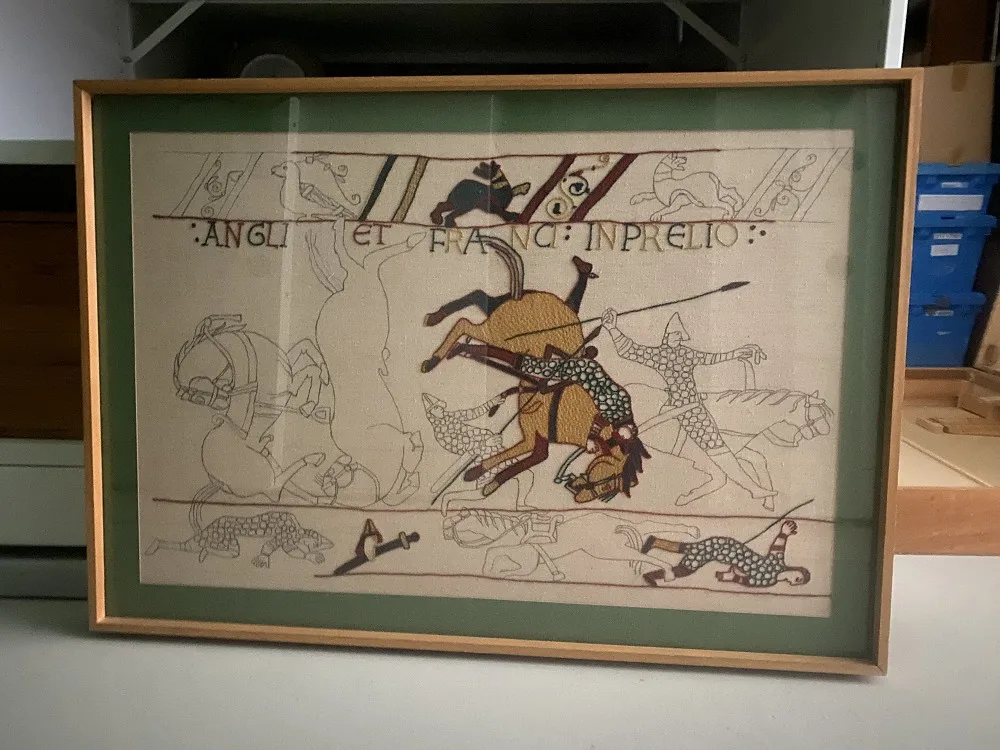
Bexhill Museum’s new stores hold a suddenly timely object: a hand-embroidered recreation of a section of the Bayeux Tapestry, finished in 1976 by Marjorie Halligan on a commission from the former East Sussex Museum Service.
When that service closed, the piece came to us. With the British Museum’s Bayeux Tapestry exhibition now attracting national attention, it deserves to be better known. Not just because of the timing, but what it tells us about the physical making of this original, perhaps the world’s best known historical record.
The section Marjorie embroidered depicts the height of the battle of Hastings. Its Latin caption reads ANGLI ET FRANCI INPRELIO — “here fell together English and French in battle” — placing it among the most dramatic passages of the tapestry, shortly before the end of the narrative.
The piece is the same width as the original and shows three stages of the embroiderer’s work in sequence: the artist’s drawn outline, the outline stitches, and areas of completed laid-work. In effect it’s a demonstration of technique as well as a copy.
There is only one full-size copy of the complete tapestry. It was made at Leek in Staffordshire in 1885 and is now held at Reading Museum. Marjorie’s is something different – a detailed, technically faithful recreation of a single extract, made for educational use.
The commission came from East Sussex Museum Service, which loaned models, equipment and documents to schools across the county up to 2020. The embroidery was made to be handled and studied by schoolchildren — expected, as Marjorie noted drily to the Worthing Herald in January 1976, to last perhaps five years. The original has lasted nine centuries.
Marjorie lived in the village of Ferring in West Sussex, was West Sussex federation crafts chairman, and was in the process of co-founding, with needlewoman Thea Nield and Isa Allen, what would become the Worthing branch of the Embroiderers’ Guild, established on 14 September 1976. Nield had been Training Officer at the Royal School of Needlework and had worked on the coronation robes for Queen Elizabeth II. Between them, the two women brought formidable knowledge to bear on the project.
The approach throughout was shaped by the constraints of accuracy and cost. Hand-woven linen being too expensive, Marjorie searched for an equivalent and eventually found a pure linen interlining material which, though very slightly darker, matched the original’s sixteen threads to the centimetre.
The 68-centimetre width gave her a mounting allowance. For thread, she tested several options — including two-ply Brussels carpet wool — before settling on crewel wool, which offered the closest match to the original and, crucially, came in a wide enough range of colours. Even so, she sometimes had to use two threads in the needle to achieve adequate coverage in the laid-work sections.
Colour matching required a visit to the source. In October 1975, travelling with a Women’s Institute group, Marjorie went to Caen — from where the tapestry is usually accessible at Bayeux — taking swatches to check against the original. “The most difficult colour to match was the yellow,” she wrote in her technical notes. “I think the one I used is slightly brighter, but it is probably the right colour of the original before it faded.”
The design was transferred using the pricking and pouncing method, working from a full-size black and white photograph. This involves tracing the design with a fine needle at intervals of no more than one tenth of an inch, pinning the tracing over the fabric, rubbing chalk and charcoal powder through the perforations, then painting a fine line along the resulting dotted outline.
Colour pictures had to be consulted throughout, as detail visible in the original was lost in the monochrome photograph. Once the fabric was prepared, it was sewn onto upholsterer’s tape to prevent uneven strain and mounted on a wooden embroidery frame measuring 36 by 27 inches.
The embroidery relies on two stitches throughout: laid-work for filled areas, and stem or outline stitch for contours and fine detail.
Laid-work looks simple but rewards close study. Long threads are laid across the surface, then a second thread is taken across at right angles and secured with tiny upright couching stitches at intervals of about one eighth of an inch. It is economical with thread and quick to work — both of which, Marjorie noted, must have mattered when the original was made and all the wools had to be spun and dyed.
The economy of thread was still relevant in 1975: she told the Herald that traditional stranded cottons and gold and silver threads were “prohibitively expensive,” and was already experimenting with lurex as a contemporary alternative.
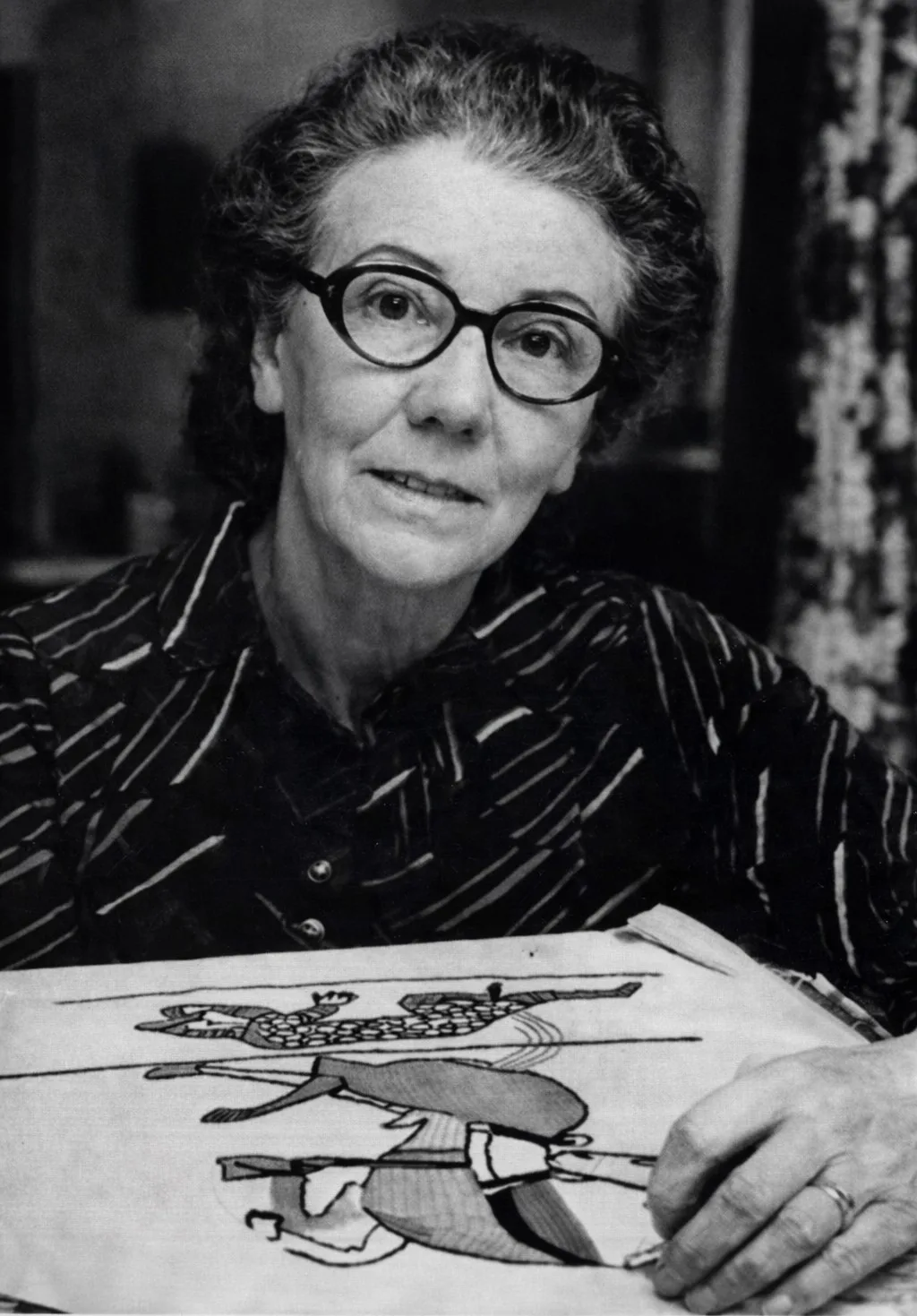
Her analysis of how laid-work functions on the horses is the most striking passage in her technical notes: “At a quick glance it appears to cover the entire shape of the animal regardless of the direction of the stitch; however on close examination it will be seen that the body is worked in sections so that the direction of the stitches indicate the limbs and muscles of the horse.”
The head required a magnifying glass: “I had to resort to a magnifying glass to see the direction of the laid-work and the intricacies of the bridle and trappings which were worked in stem stitch.” She considered the horses “the finest example of the laid-work technique” and was glad the museum service had chosen a section that included them.
The chain mail circles, worked in stem stitch, presented a different challenge: producing a smooth, unbroken line around a very small circle. Even the soldiers’ leggings and shoes required detailed study to determine stitch direction. Nothing, it seems, could be embroidered on autopilot.
Marjorie was originally asked to make two copies of the same extract. She resisted. Not wanting repetitive work, she proposed instead a continuation — a second section advancing the narrative rather than duplicating it. The same photograph could be used as a reference, but she had the continued interest, as she put it, of “discovering the direction and use of the stitches in the second extract.”
“I have very much enjoyed working on this project,” she wrote at the end of her notes, “and the opportunity of detailed study of my favourite embroidery.”
That enjoyment is evident in the piece itself. The Bayeux Tapestry was, for Marjorie, “the first strip cartoon” — a work that “reflects the pleasure that the workers found in making it.” Fifty years on, her copy carries something of the same quality.
♦ The Worthing branch of the Embroiderers’ Guild that Marjorie Halligan co-founded in September 1976 — just months after completing the work — is still active today as Southdowns Creative Stitchers, now with 70 members.
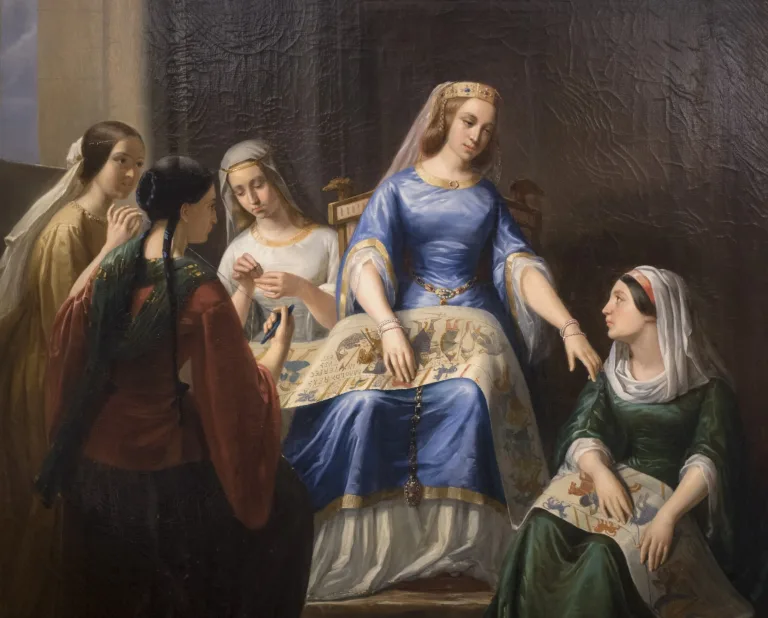
♦ Title image: Queen Mathilda working at the Bayeux Tapestry. Painting by Alfred Guillard (1810–1880) Museum of Art and History Baron Gérard, Bayeux (P0361).