

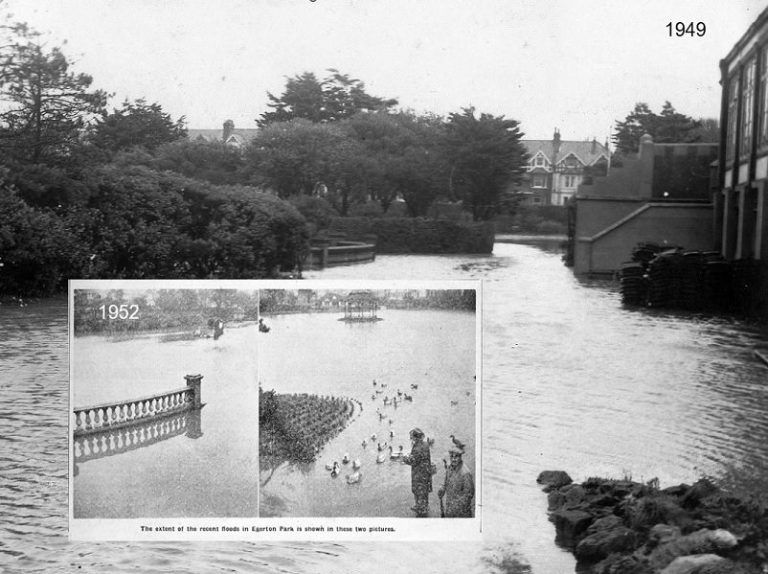
Anyone who spends time in Bexhill’s Egerton Park knows that it doesn’t take much rain for its lawns to start turning into extra lakes. After a big downpour — especially when it happens around high tide — the puddles can grow into whole temporary ponds. It’s something most of us have seen many times, but the reasons behind it aren’t always obvious.
What’s going on is mostly to do with the stream that runs from Sidley to the sea. Most people never see it, because for over a kilometre it flows underneath the town in large pipes. At the bottom of the park, just before the beach, the stream connects with pipes taking the storm waters from Bexhill’s gutters, and from there a tidal gate. When the tide is low, water can escape out to sea. When the tide is high, the gate shuts to stop seawater pushing back inland.
This simple system works well most days. But when heavy rain arrives at the same time as a high tide, the water in the pipes has nowhere to go. It backs up into the park instead. That’s why the lakes spill over, paths flood, and the grass ends up sitting under several inches of water until the tide drops again.
Egerton Park has always been prone to this kind of flooding — the history goes back more than a century — but in recent years it feels like it’s been happening more often, thanks to climate change and the warming of the atmosphere and seas. Warmer air can hold more water vapour — around 7% more for every 1°C of warming — so when rain falls, it tends to fall harder and in shorter bursts rather than as steady drizzle.
Warmer seas around the UK add to this effect by increasing evaporation. Moist Atlantic air masses carry more water inland, which can be released very rapidly when the air is forced to rise by weather fronts or low-pressure systems. There are also more ‘convective’ storms. Warmer surface temperatures make the atmosphere more unstable, leading to sudden, intense downpours and thunderstorms that deliver large volumes of rain in minutes rather than hours.
At the same time, weather systems are sometimes moving more slowly. Changes in large-scale circulation, including a weaker and more erratic jet stream, mean rain-bearing systems can linger over one area, greatly increasing local rainfall totals. Finally, hard surfaces, culverted streams and constrained drainage like our tidal outfall — make heavy rain feel more extreme, increasing runoff and reducing the system’s ability to cope.
In combination, these factors mean the UK is seeing rain that falls harder, faster, and with more disruptive consequences, even if total yearly rainfall does not rise dramatically. Climate change has another effect: higher sea levels mean high tides will last longer, which in turn means the tidal gates will be closed more often. New planning rules now ask councils to take this into account when thinking about flood risk in Bexhill.
Bexhill Museum, just south of the lakes between it and the sea, sits slightly higher than the lowest parts of the park and hasn’t been flooded internally for decades, but it’s still close enough to the action that we’ve had to take the risk seriously.
Non-return valves were fitted to the Museum drains in 2021 to stop flood water backing up into the building. We’re adding new flood doors that seal themselves as water rises, and we’re applying waterproof membranes to parts of the lower floor to stop moisture pushing through when the surrounding ground is saturated. These improvements don’t change how the park floods, but they do mean the museum is far better protected if it does.
Over the past decade or so, quite a lot has been done behind the scenes to help. A huge underground storage tank was built upstream in 2008 as part of the Link Road project. It holds thousands of cubic metres of stormwater and takes a lot of pressure off the system during heavy rain.
The lake in Egerton Park serves a similar purpose. Rother contract staff can open the sluice valve to lower the water levels in the park’s lake in advance of bad weather and the overflow from the town’s storm drains can flow there there until the tide changes and the sluice gate to the sea opens.
There’s also some very promising work happening upstream in Sidley Woods. Bexhill Wild CIC is leading a project to slow down the flow of water before it even reaches the culverts. They’re planning simple natural features such as leaky dams and small ponds that help the ground soak up more rainfall and release it more slowly. It’s a low-tech approach, but it often works surprisingly well. If approved and delivered at scale, it could make a big difference to how quickly water reaches Egerton Park during a storm.
None of these steps will remove the risk entirely — and Egerton Park will always be one of the town’s natural flood points — but taken together they add up to a much more resilient system than we had 10 or even 20 years ago. The combination of engineering, natural solutions and practical upgrades means that Bexhill is far better placed to cope with heavy rain and high tides than it used to be – but climate change will keep the pressure on.